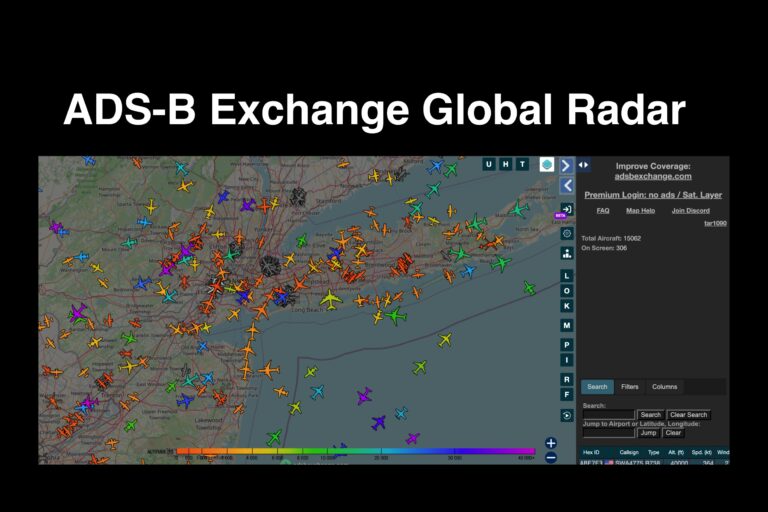
ADS-B Exchange is a public aircraft tracking network that provides a live global map showing real-time aircraft positions using Automatic Dependent Surveillance–Broadcast (ADS-B) signals transmitted by airplanes. Unlike many commercial flight-tracking websites, the platform does not filter government, military, or private aircraft when the data is publicly broadcast, making it a widely used open-source intelligence (OSINT) tool for researchers and journalists.
Every aircraft equipped with ADS-B transmits identifying information including location, altitude, speed, and flight path. The site collects these signals through a worldwide network of volunteer receivers and displays them on an interactive map. Users can click an aircraft to view its route history, registration information, and movement patterns. This allows investigators to observe flights to remote airfields, unusual routing behavior, repeated travel between specific locations, or aircraft linked to corporations, government agencies, or private operators.
For investigative research, flight tracking is a powerful verification method. Reporters and watchdog groups often use ADS-B data to confirm travel timelines, identify previously undisclosed meetings, track logistics routes, and correlate movement with known events. The tool is especially valuable when combined with public records such as aircraft registration databases, corporate filings, court cases, and reporting. It helps answer questions like who traveled, when they traveled, and where they actually went.
Because the system shows only publicly broadcast transponder signals, it should be used as a corroborating source rather than standalone proof. Some aircraft disable or mask transmitters, and interpretation requires careful cross-checking. When used responsibly, however, it provides a rare form of real-world, time-stamped activity data available to independent researchers.
In practical terms: it lets you watch aircraft movement in real time — and sometimes that reveals connections documents alone cannot.