
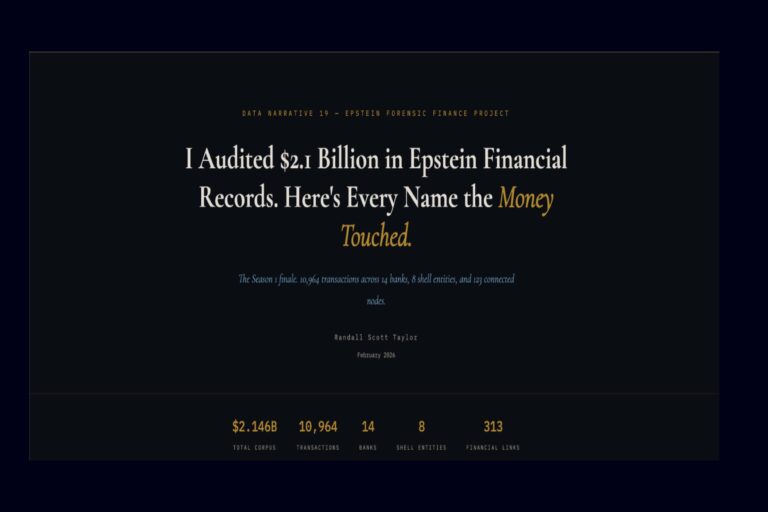
Epstein Forensic Finance is an independent analytical research project examining financial relationships, corporate structures, and transactional patterns connected to Jeffrey Epstein’s known network. The “Grand Opus Narrative” section presents a long-form investigative walkthrough that attempts to map financial connections using public filings, corporate records, and transaction logic rather than relying solely on witness testimony or media reporting.
The value of the project is methodological. Instead of focusing on personalities, it focuses on financial pathways — shell companies, asset transfers, corporate registrations, investment vehicles, and institutional relationships. For researchers learning financial investigation, this approach demonstrates how forensic accounting and open-source intelligence (OSINT) can be used to identify associations between individuals, entities, and organizations.
Financial network analysis is a core investigative technique. Many large criminal and corruption investigations — including fraud, trafficking, sanctions evasion, and money laundering — are solved by tracing money flows rather than statements. Projects like this illustrate how public corporate filings, nonprofit disclosures, property records, and offshore entity registrations can reveal relationship structures that are otherwise invisible.
Because the work is an independent research analysis, it should be treated as an investigative hypothesis and mapping resource rather than a verified legal finding. Its practical use is educational and investigative: it helps researchers understand what records to search, how shell companies function, and how complex influence networks can be reconstructed using publicly available data.